
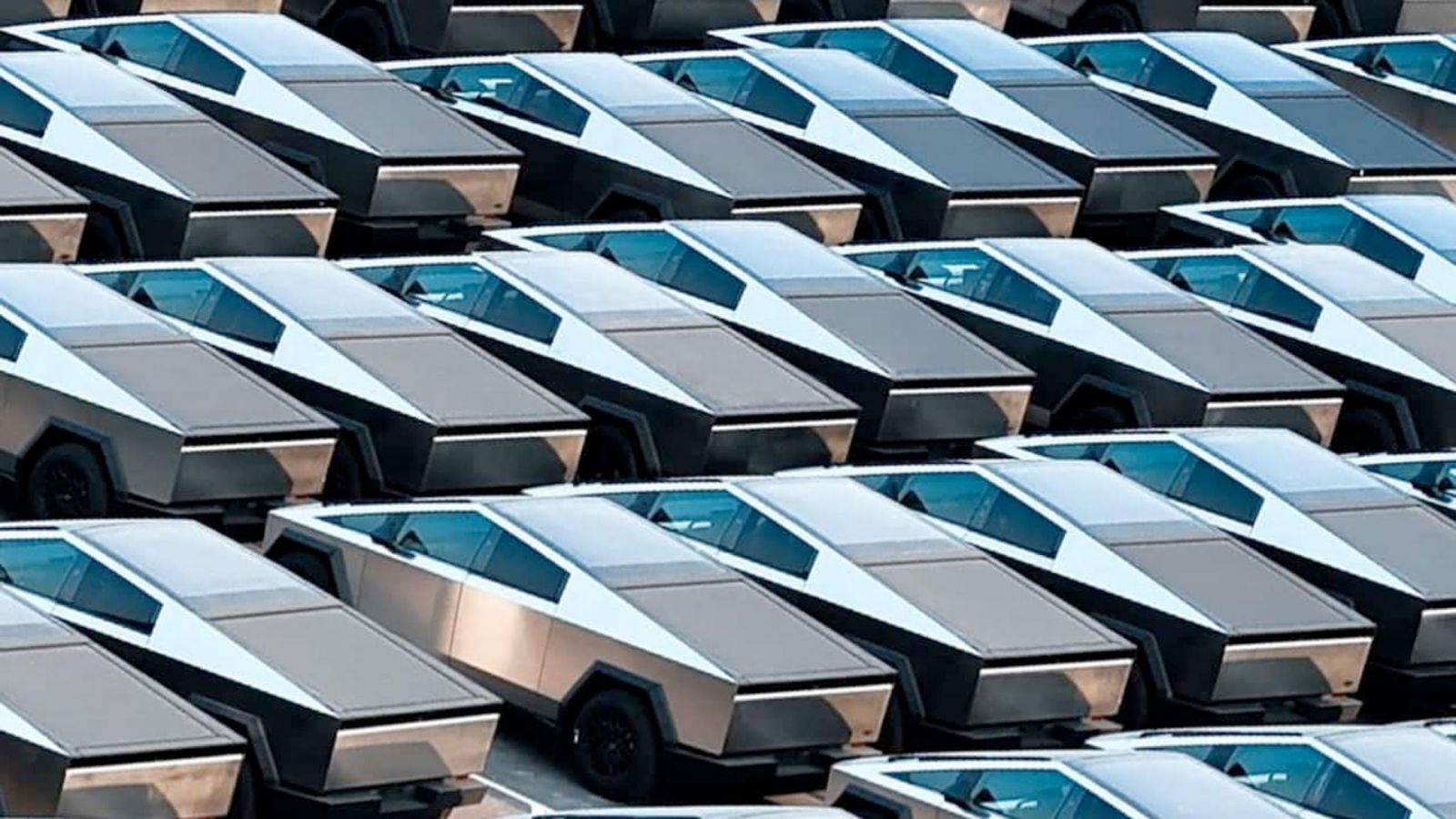
Unsold Tesla Cybertrucks
Buyers of some new electric cars could easily end up with a near-worthless lemon, says the car review website dogandlemon.com.
Editor Clive Matthew-Wilson, who is an acknowledged expert on the car industry, warns:
“The whole automotive industry knows there’s a big meltdown ahead for electric carmakers. If you buy an EV from a company that goes bust, you’ve basically blown your money. Sadly, many electric car brands may simply not exist in five years time."
The American Rivian electric pickup company was once expected to be a global rival to Tesla. However, today, Rivian appears unlikely to survive. Rivian’s quality is appalling and Rivian has made substantial losses every financial quarter, including a loss of over $1 billion in the first quarter of 2025. The company lost $4.7 billion in 2024.
“Even Tesla is in trouble. Tesla is probably too big to fail, but a major restructuring seems inevitable.”
Matthew-Wilson adds:
“The electric car industry is roughly where the fossil car industry was 100 years ago. Manufacturers come and go on a regular basis and the quality is often patchy.”
AlixPartners, a global consulting firm, recently predicted in the New York Times that only 15 of the 129 Chinese EV brands will be financially viable by 2030.
Matthew-Wilson asks:
“So what happens to the buyers of EVs from the other 114 EV companies?”
Matthew-Wilson warns:
“400 Chinese EV companies ceased operations between 2018 and 2025."
China’s top economic planning agency recently warned BYD and other Chinese EV companies to stop selling cars below cost, as this strategy may lead to serious problems for the entire industry.
BYD was also recently accused of importing large numbers of EVs into Australia, largely to take advantage of government carbon credits.
A high-risk industry
China faces unique problems with its EV industry. Matthew-Wilson explains:
“The Chinese property market no longer generates the wealth to drive the Chinese economy. Therefore, the Chinese government openly encouraged thousands of EV start-up companies. These companies often enjoyed covert subsidies, such as easy finance and very cheap electricity to run their factories. That’s one reason Chinese cars are so cheap.”
“The Chinese government is determined to dominate the EV world and believes in survival of the fittest. The Chinese government knows that, in the long term, only a small handful of Chinese EV manufacturers will survive. But these survivors will probably grow to dominate the planet."
Matthew-Wilson predicts: “Some struggling EV companies will be absorbed by their more successful rivals. But the rest of the unsuccessful EV start-ups will probably be left to die, often stranding their customers.”
The recent bankruptcy of the Chinese Neta Autos has triggered a stampede of buyers away from this brand.
Matthew-Wilson points out:
“Once a brand’s future is in doubt, potential customers will avoid it like the plague, due to fears of being left with a lemon. This stampede then makes it even harder for the bankrupt company to reorganise and survive. Once several companies go bankrupt at the same time, the entire market is likely to panic.”
Neta had planned to expand into the New Zealand and Australian markets, but went bankrupt first.
Neta, along with fellow Chinese electric vehicle maker Zeekr, has been accused of inflating sales figures by registering vehicles as sold, even though these vehicles were actually sitting, unsold, in showrooms.
Matthew-Wilson emphasises that he’s not dissing Chinese cars.
“The quality of Chinese vehicles improves with each passing year. China will probably dominate the global car market for the next fifty years, in the same way Japan has lead the global car market for the last fifty years.”
“The problem is this: there are too many companies building electric cars, and most of them will not survive.”
Beware of geeks bearing gifts
Former New Zealand climate change chair, Dr Rod Carr, supports the mass purchase of electric cars as a means of addressing climate change. Carr recently claimed:
“Electric motors last longer than internal combustion engines, electric cars have fewer moving parts, less wear and tear.”
Matthew-Wilson, who is a motor mechanic and former garage owner, respects Dr Carr, but says Carr appears to be misinformed on this subject.
“How does Carr know EVs are now as reliable as conventional cars? Most EVs haven’t been around long enough to prove themselves in the longer term.”
According to the giant American Consumer Reports organisation:
“In place of traditional problems, such as those with the engine and transmission, trouble areas for EVs include the electric motor, EV / hybrid battery, and EV charging systems.”
Matthew-Wilson asks:
“Perhaps Dr Carr would like to advise EV buyers which electric car companies are likely to survive the mass bankruptcies that lie ahead for the industry?”
“In the meantime, anyone considering an electric vehicle should be aware that the company that built this vehicle may not be around when this EV needs (say) a new charging socket. If the company that built the vehicle ceases to exist, then the warranty on this vehicle will be effectively meaningless."
“Under New Zealand consumer law, your contract is with the company that sold you the car here. If the manufacturer of the car goes broke in America or China, then the dealer in this country will probably go broke too. When something goes wrong with your EV, you’ll probably have great difficulty getting support, particularly spare parts. So, your expensive EV may quickly become near-worthless scrap.”
“Electric cars are extremely complex and prone to electronic problems. My neighbour bought a new $130,000 Tesla Model 3. It broke down three times, including once on the outer lane of Auckland’s Northern motorway. People get killed in situations like this."
“After discussions with Tesla, they agreed to take the vehicle back and refund the owner’s money. But what will happen when a poor person ends up buying this lemon in a few years time?”
Things will improve, but not yet
“In five to ten years' time, the EV wars will probably be over and consumers should be able to buy reliable EVs at an affordable price, with a long and valuable warranty. But right now, I would be cautious buying any EV from a company that didn’t exist 20 years ago.”
EV subsidies may prove to be a poor investment
“Encouraging Kiwis to buy EVs under current circumstances, especially with government subsidies, seems utterly mad.”
“The now-discontinued government EV subsidy was effectively a gift to car companies and wealthy people who would have purchased an EV anyway.”
Matthew-Wilson adds:
“The biggest beneficiary of New Zealand electric vehicle subsidies was Elon Musk.”
He believes that vehicle subsidies generally fail because they target new cars.
However, Matthew-Wilson points out:
“Many Kiwis never buy a new car, simply because they can’t afford to.”
“A friend of mine is in her mid-70s and lives in the country. Her knees give problems that make walking or cycling painful. She drives an ancient Toyota Camry that has never stranded her. She could not afford a new car, even with a hefty subsidy. Yet urban Greens seem to believe she can simply buy a subsidised new electric car and solve all her ethical transport problems.”
Most car owners never buy new
Aside from commercial or luxury car purchases, a large percentage of new car sales are to retirees, who want their final vehicle to last for as long as its owners.
“Currently retirees are buying huge quantities of new electric vehicles. But the average car owner could never afford this kind of purchase."
“Unfortunately, there probably won’t be waves of cheap, affordable used Japanese electric cars, because many shipping companies won’t carry them, due to the fire risk.”
“Electric cars actually catch fire less often than conventional cars, but when they do catch fire, they can be really hard to extinguish, and they’re really toxic.”
“Used car buyers typically spend between $5000 and $20,000 on their vehicles. But I know plenty of people who’ve never spent more than $5000 on a car in their whole lives.”
"The idea of the New Zealand EV subsidy was fine: it was supposed to decarbonise the fleet, and expensive Teslas would become affordable transport for poor people five years later. However, I would probably not buy a new Tesla and I would never buy an old one. Many of the poor people who buy those previously-subsidised Teslas when they become cheap, may end up wishing they’d simply bought a Toyota Prius.”
The need for practical, here-and-now solutions
“In place of EVs with a doubtful future, the government should be investing in rail, discouraging the use of longhaul freight trucks, and encouraging the purchase of durable, proven vehicles such as Toyota hybrids.
All manufacturers exaggerate fuel-use figures, but Toyota hybrids generally give pretty good fuel economy and a level of reliability that many EV owners can only dream of. That’s why virtually every New Zealand taxi is a Toyota hybrid.”
