
The New Zealand trucking industry should contribute to the costs of essential transport infrastructure, such as the inter-island ferries, says the car review website dogandlemon.com.
Dogandlemon.com editor Clive Matthew-Wilson, who is outspoken on road safety and transport issues, says:
“After blowing $671 million for the costs of cancellation of the previous ferry project, the government is to spend more that twice this amount ($1.7 billion) to provide less.”[1]
“The trucking industry could not function without the interisland ferries, yet doesn’t pay anything like the actual costs of these ferries. It buys a ticket for the truck, but the taxpayer builds and maintains this essential link between the two islands.”
“Worse, the trucking industry, supported by groups such as the Taxpayers’ Union [2], fought long and hard to keep roll-on-roll-off rail off the new Picton ferries. [3]
"This would have effectively gifted the trucking industry a monopoly over carrying bulk freight over Cook Strait." [4]
“It’s impossible to over-emphasise the importance of rail freight. We already know from our experiences after the Kaikoura earthquake that freight trucks simply couldn’t cope.”[5]
“For years, the trucking industry has been selling the lie that rail is uneconomic while trucks are far more efficient. Actually, the opposite is true. The only reason that the trucking industry is profitable is because it’s effectively sponsored by the taxpayer.”
Multiple studies have shown that rail is also vastly more energy-efficient and produces far less emissions than trucks. [6]
“Want to know why our roads are in such poor condition? Blame the trucking industry.”
“About two thirds of the cost of building new highways goes into making them strong enough for large vehicles, which are mainly trucks. Excluding events such as storm damage, about 80% of all road maintenance costs are the result of the damage caused by trucks.”
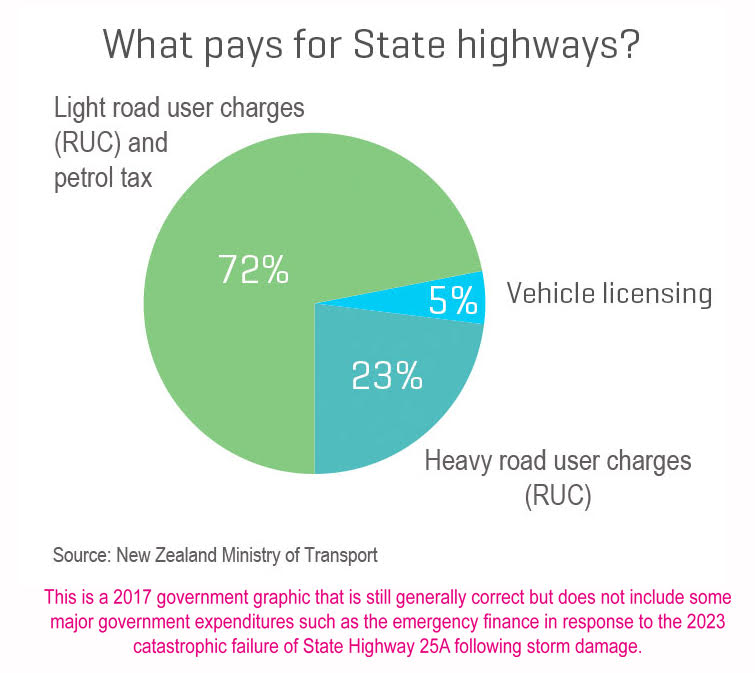
“Yet, the trucking industry pays less than a quarter of the costs of building and maintaining these highways.”
Matthew-Wilson believes the government should make the trucking industry pay the full costs of the damage they cause and should contribute a substantial proportion of the transport infrastructure that keeps the trucking industry alive.
“I urge the government to ignore the trucking industry’s bullshit about being more efficient. The government’s own studies show that rail freight is at least twice as efficient as road freight.” [6]
“Moving freight by sea is also many times more efficient than trucks. The only reason that trucking companies prosper is because they don’t pay the true costs of the roads they travel down.”
“We need milk tankers and delivery trucks. We don’t need most of the longhaul truck-and-trailer units that roar down our state highways and get a comfy ride over Cook Strait, largely at the taxpayers’ expense.”
“Truck drivers are not the enemy here. The enemy is a cosy historical arrangement between the trucking industry and the government, that allows the trucking companies to grow rich at the taxpayers’ expense.” [7]
[1] The major costs of the previous project were not in the ferries but in the infrastructure associated with the ferries; specifically, the dockside improvements needed to safely handle an increase in freight and passengers.
[2] The New Zealand Taxpayers' Union (NZTU) regularly advocates for transport policies favoured by the trucking industry. Critics and media point to shared political goals, but the NZTU states it does not disclose its private donors and that less than 3% of its total budget comes from all industry groups combined
[3] Efficient train ferries are ‘roll-on, roll-off’: that is, complete trains except locomotives are driven directly into one end of the ferry at the beginning of the trip and out the other end when the destination is reached.
The trucking industry’s proposed new ferries would still have been able to carry rail freight, but only by unloading the freight from the trains and then loading and unloading the freight in and out of the ferry, then back onto trains at the other end. This is a vastly less efficient system that effectively makes long haul rail freight uneconomic.
So, if trucks could use the ‘roll-on, roll-off’ system on the ferries while rail couldn’t, the trucking industry would effectively have been gifted a monopoly for long haul freight between the islands.
[4] The trucking industry doesn’t want to entirely eliminate rail freight; trucking companies such as Mainfreight make extensive use of the rail system. However, the trucking industry as a whole wants rail freight to be a healthy dwarf that can carry freight for trucking companies but can’t effectively compete with freight trucks, because the system is rigged in favour of trucks.
[5] Pre-earthquake, the South Island rail network was carrying around 1 million tonnes of freight annually. Post-earthquake, the immediate challenge was diverting drivers from the closed SH1 between Christchurch and Picton to the alternate route along State Highways 63, 6, 65 and 7 (and the alpine Lewis Pass). These roads are narrow and winding in places, with single-lane bridges and an alpine pass, which can be treacherous when wet and during the winter months.
Vehicle numbers on this route quickly rose four-fold to 4500 vehicles per day, with 1000 of these being heavy vehicles, up from the 350 pre-earthquake. https://www.nzta.govt.nz/projects/kaikoura-earthquake-response/moving-mountains/the-challenge-restoring-road-and-rail-routes-and-a-marina/
[6] Coastal shipping produces one fifth of the carbon emissions (well-to-wheel) of road freight. Rail produces about a quarter of trucking emissions. https://www.canterbury.ac.nz/content/dam/uoc-main-site/documents/pdfs/reports/data_interaction_report_24_03_2023_FINAL.pdf
[7] About three-quarters of the funding supporting the expenditure on managing and developing the roading network comes from Waka Kotahi, using the revenues mainly collected from road users through fuel excise duty, road user charges and vehicle licence fees. A further 20% comes from local authorities. The Crown also directly provides a small part of the total, much of which in 2018/19 related to the payments for the Kaikoura earthquake response and so would vary from year to year.
https://www.transport.govt.nz/assets/Uploads/DTCC-Main-Report-June-2023.pdf
